Fighting for your whole life with Desiree
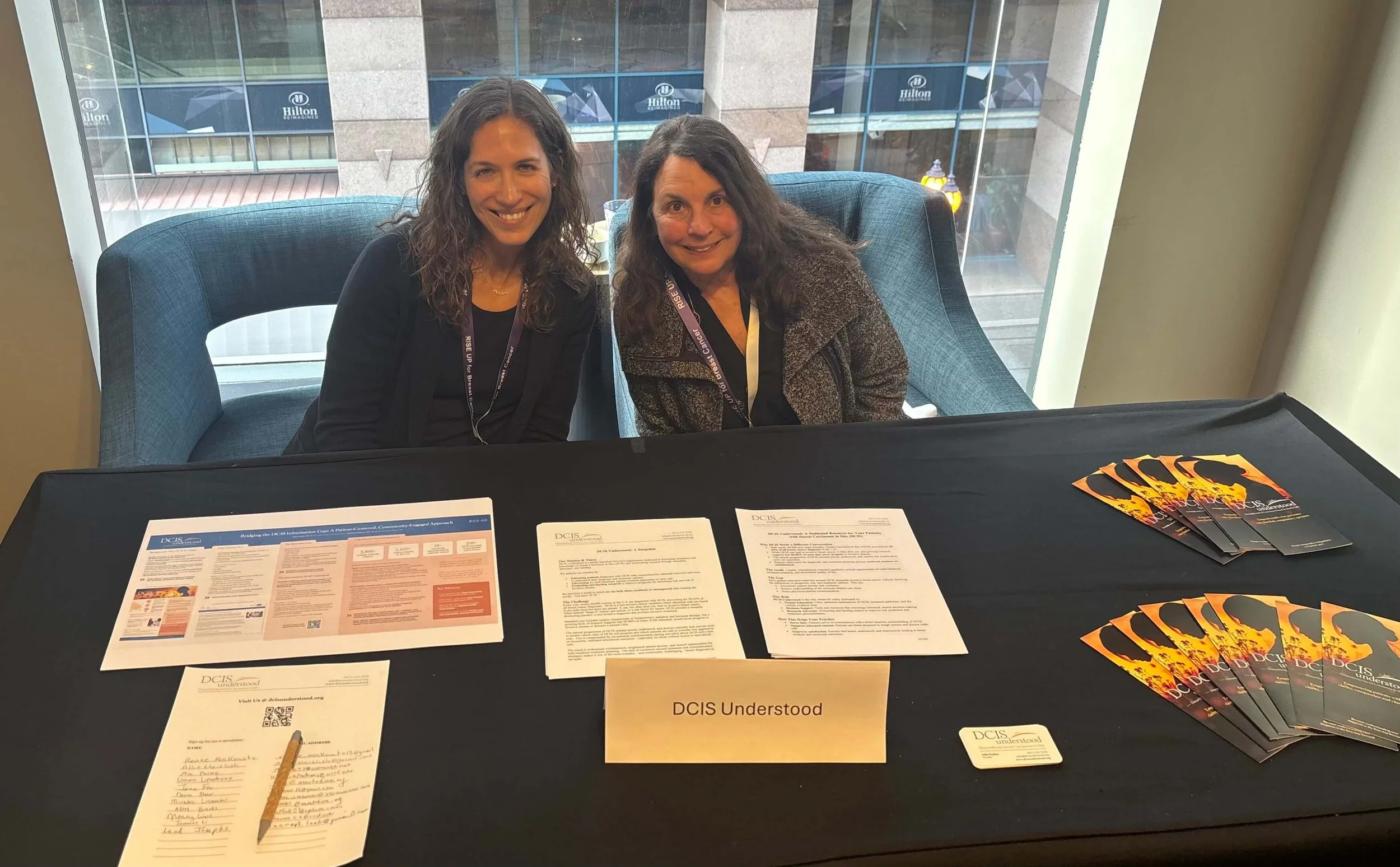
Desiree Basila (right), with Julia Stalder (left), representing DCIS Understood at a conference
When faced with a threat, many of us would fight for our life–take action, just do whatever it takes to eliminate the threat, feel safe and return to homeostasis. That is often the Western medical model presented to us—take aggressive action to treat the presenting problem–excise it, medicate it, radiate it, kill it. The problem is that this doesn’t happen in a vacuum–it’s in our bodies, inextricably part and parcel of our living. Whatever happens to the body, happens to us, and the psychobiological effect is indelible.
Doctors are tasked with keeping bodies alive and to do no harm. They are less concerned with overall quality of life because if the body is dead, there’s not much quality to be had.
So when patient Desiree Basila was handed a confusing diagnosis of stage 0 breast cancer, otherwise known as Ductal Carcinoma in Situ (DCIS), nearly 20 years ago, she was perplexed. She heard “5cm lesion” and “carcinoma” and “stage 0”. Was this cancer? It certainly was being treated as cancer. (For context, DCIS is a lesion confined to the breast ducts. A percentage have a risk of becoming invasive, but most don’t. The challenge of course is discerning which is which.) Desiree was in a season of life where movement was critical as a dancer–and also feeling respected in her body. As she waded through treatment options with her oncologist (surgery, radiation, hormone-blocking therapy), she began to explore: what was most important to her in this chapter of life? She had made peace with facing death. Did she want to undergo intense treatment to be so limited in doing the things that brought her immense joy?
So when she asked her oncologist Shelley Hwang, “what if I do nothing?”, she was understandably met with surprise and caution. This was not standard of care for DCIS. Providers were confused–why wouldn’t you fight for your life? To her credit, Dr. Hwang was willing to entertain the possibility. Hwang had begun to question the usual management of DCIS herself, and she cared about Desiree’s quality of life as a whole person, not just the diagnosis. Dr. Hwang and Desiree together pioneered active surveillance as a treatment for DCIS–for those who are low-risk to explore frequent screenings, often with low-dose endocrine therapy, instead of surgery/radiation/normal dosage. Desiree tried Tamoxifen for a brief period but found herself so depleted, she decided going through life in such a condition wasn’t worth it, and stopped. She would rather “be dead than feel dead.”
I met with Desiree recently, and asked her about her psychological experience of the whole endeavor. She admitted her initial approach had been to “go solo” at all costs, geographically separated as she was in 2007 from family and “from womb to tomb” friends. Thankfully, she didn’t have to–the Patient Resource Center at UCSF breast care center provided education, an Art for Recovery program, decision making services and therapy sessions with a dedicated psycho-oncologist. She would later transition to an external therapist and a host of integrative care resources that supported and cushioned her in her resolve to do active surveillence.
"Education is so important. Even though I already had a biology background, I was so fortunate to have all these amazing resources that helped me integrate my understanding - biological, spiritual, social, emotional. At the time, I thought it was common to all oncology centers, but would later realize it is actually rare. Taken together, all of these providers made it possible for me to believe–to have the courage to, in a sense, pioneer a new way to manage DCIS."
Desiree acknowledges that active surveillance is no “walk in the park”. It’s a considerable mental load of uncertainty, and lots of logistics to juggle–adapting to inevitable changes of doctors, insurance and moves. Though she’s had health challenges since her initial DCIS diagnosis, she’s at peace with her decision–one could argue that she indeed did fight for her life–on her terms, not just eradicate x at all costs. Today, she’s a fierce advocate for women to receive individualized treatment for DCIS, to be considered as unique bodies–one treatment can’t fit all, and might even cause unnecessary harm. She’s fighting not just for her life, but for others.
Desiree Basila is a member of the Patient Leadership Team of the COMET study (COMETstudy.org), and a DCIS advocate with DCIS Understood. She was featured in the Time article “Why Doctors Are Rethinking Breast-Cancer Treatment” in Oct 2015. She can be reached at dlbasila@gmail.com.